
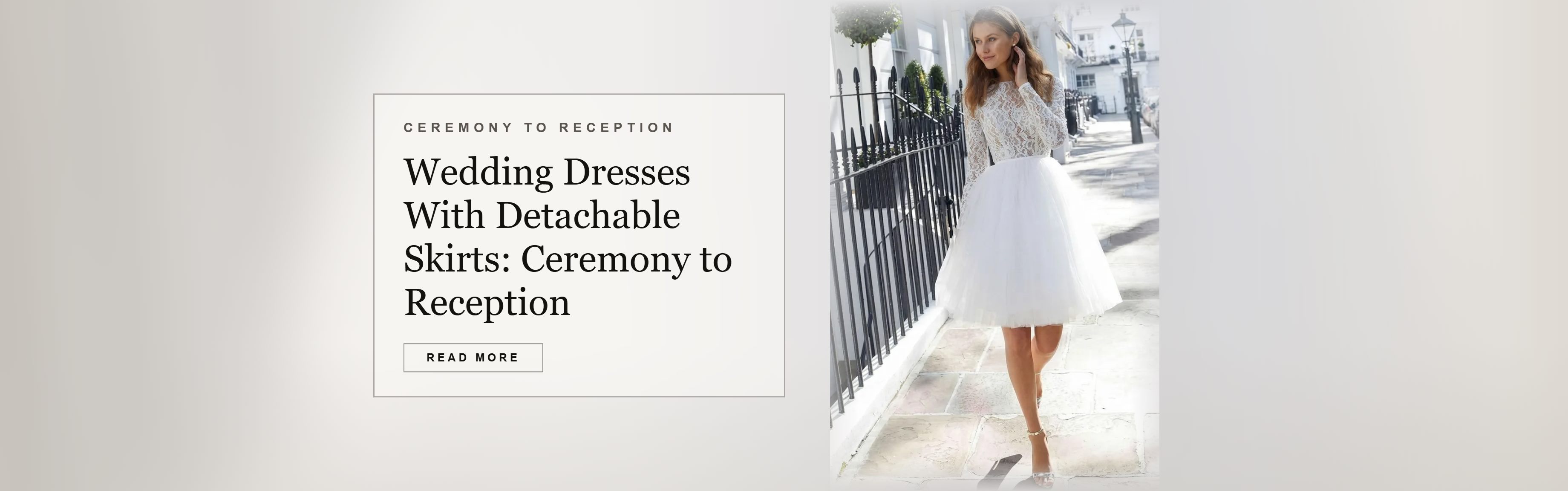
A detachable skirt is a full outer layer that wraps your lower body and lifts away to reveal a different silhouette underneath.
Unlike a train, which only adds length behind you, an overskirt changes your shape from every angle — which is why it gives you two genuinely different looks from one gown.
The catch is that both looks have to work. An overskirt hides the base dress completely during the ceremony, so brides tend to choose on the strength of the outer layer and discover the inner one on the day.
| Overskirt | Wraps the whole lower body, changes the silhouette from the front as well as behind |
| Detachable train | Attaches at the back only, adds length rather than volume |
| Best pairing | Full tulle or satin overskirt over a fitted sheath or mermaid base |
| The real test | Whether the base dress alone would be a gown you would have bought on its own |
The rule worth remembering: allow 3-4 weeks with a local tailor for a two-part gown rather than the usual single-dress allowance, because the overskirt and the base have to be fitted separately and then checked together.
What is a detachable skirt, and how is it different from a train?
The words get used interchangeably in product listings, but the constructions are not the same, and the difference decides what your reception photographs look like.
An overskirt is a garment; a train is a panel
An overskirt is closed or wrapped around your waist and falls all the way round, often over a fitted underdress. Take it off and your outline changes completely — from full to fitted.
A detachable train attaches at the back and trails behind. Remove it and your outline from the front is exactly the same as it was during the ceremony.
How overskirts fasten
Most wrap and fasten at the waist with hooks and a concealed tie, sitting over the base gown's own waistband. Some button along one hip so the opening reads as a deliberate front split rather than a seam.
The fastening you want depends on whether you plan to remove it alone. A side-buttoning overskirt is manageable solo; a back-hooked one is not.
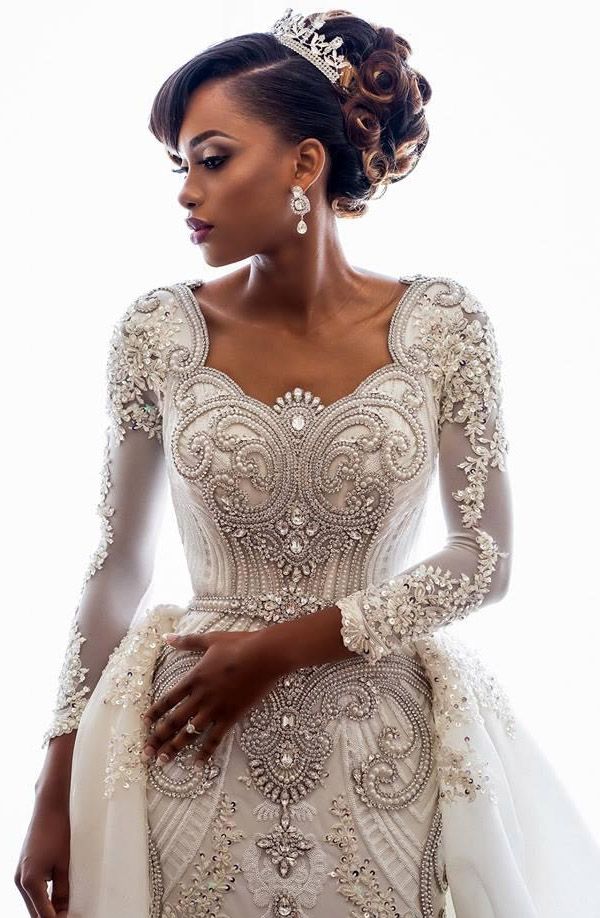
Two-piece gowns are a third option
A genuine two-piece separates the bodice from the skirt entirely, so you can change the skirt rather than remove a layer. This is the most flexible construction and the most demanding to fit, because the join at the waist has to be exact from every angle.
Detachable sleeves belong in the same family
Removable sleeves follow the same logic: full coverage for a ceremony, bare shoulders for the reception. They attach at the armhole seam or clip to the strap, and they are the easiest of all the modular pieces to take off yourself.
How does the ceremony-to-reception change actually work on the day?
Smoothly, if you have decided in advance where and when it happens. Badly, if you assume you will work it out between the speeches.
Decide the moment before the day
The natural points are after the ceremony and photographs, or just before the first dance. Removing an overskirt during dinner means standing up mid-service and finding somewhere to put a large volume of tulle.
Most brides who plan it choose the first dance, because the change reads as intentional and the reveal has an audience.
You will need one person and two minutes
An overskirt with back fastenings needs a helper. Brief whoever it is in advance, ideally with a practice run at your final fitting, because the person who has never seen the fastening will spend five minutes looking for it.
Where the skirt goes afterwards
This is the logistics question nobody asks until it is too late. An overskirt is bulky, pale, and expensive, and it has to survive the rest of the evening somewhere clean and dry.
Agree a place before the day — a garment bag in a locked room, not a chair back.

What the change does to your photographs
Two silhouettes give your photographer two distinct sets of images without a second dress. Tell them the change is happening and roughly when, so the reveal is covered rather than missed.
Which base dress should you build a two-part gown on?
The base has to be a dress you would wear on its own. Everything else follows from that.
Fitted bases give the biggest contrast
A sheath or mermaid underdress beneath a full overskirt is the most dramatic pairing available in bridalwear: ballgown volume for the aisle, a clean fitted column for the dance floor.
It is also the pairing that most rewards accurate measurements, because the moment the overskirt comes off there is nothing between the dress and you.
Short and tea-length bases are the underrated choice
A short base under a floor-length overskirt gives you a full-length ceremony gown and a knee-length reception dress. For an evening that runs late, or a venue with a lawn, this is the most practical version of the idea.
Sleeves and necklines carry the formality
If the base dress has long sleeves or a high neck, it stays ceremony-appropriate on its own. That takes the pressure off the overskirt and makes the change feel like a styling choice rather than a costume change.
None of this is new
Brides have been building convertible wedding clothes for two centuries.
The V&A holds an 1820s wedding dress that, as the museum's conservators record, "came to us with two sets of sleeves — a long pair for the wedding day had been removed and replaced with a short set that would be suitable for the ballroom".
That dress was altered again in the 1890s, giving it over 70 years of wear. The modern detachable skirt is the same instinct with better hardware.
The COCOSBRIDE Difference: one gown doing the work of two
A two-part gown is the most economical way to get two bridal looks, and made-to-order construction is what makes it viable. Both layers are cut for the same body at the same time, so the overskirt sits where the base gown's waist actually is rather than where a sample size put it.
It also opens up the colour question. Because these gowns are made to order, the base and the outer layer can be considered as a pair — an ivory base under a white overskirt, or a champagne underdress that only reveals itself at the reception.
The colour options and fabric swatches are shown on each product page.
If a style you like has a fixed skirt and you want it removable, that is a construction change rather than a size change, so it has to be assessed before you order. Email service@cocosbride.com with the style number and ask.
Start with the train wedding dresses collection for the two-in-one constructions, or browse our full made-to-order range if you are still comparing shapes.
Shop the Look: Detachable Skirt and Two-Piece Wedding Dresses
Each of these is made to order and built around a base gown that stands on its own — the test that matters most for a two-part look.




If length behind you matters more than volume around you, the companion piece to this guide is our breakdown of detachable train wedding dresses, which covers attachment hardware and train weight in detail.
The same one-garment-many-looks thinking runs through the wedding party too — see how convertible bridesmaid dresses let a whole party wear the same dress differently.
Frequently Asked Questions
What is the difference between a detachable skirt and a detachable train?
An overskirt wraps the whole lower body and changes your silhouette from the front as well as the back, while a train attaches behind you and only adds length. Removing an overskirt changes your shape; removing a train does not.
Can I take the overskirt off by myself?
Only if it fastens at the side or front. Back-hooked overskirts sit where you cannot see or reach, so brief one person in advance and practise the removal at your final fitting.
When should the ceremony-to-reception change happen?
After photographs or just before the first dance are the two natural moments. The first dance is the more popular choice because the change reads as intentional and has an audience.
Does the base dress need to be a complete dress on its own?
Yes, and this is the single most important test. The overskirt covers the base entirely during the ceremony, so brides often choose on the outer layer and only discover the inner one on the day.
Can a fixed skirt be made detachable?
Sometimes, but it is a construction change rather than an alteration, so it has to be assessed before you order. Email service@cocosbride.com with the style number and ask whether that design can be built as a two-part gown.
Where can I find two-in-one wedding dresses that are in stock?
The train wedding dresses collection holds the two-in-one constructions, all made to order in your measurements.
About the Author
Elena Marsh is a bridal and formalwear writer specialising in wedding dress construction, detachable and convertible design, silhouette selection, and made-to-measure fit. She writes practical shopping guides that help readers balance style, fit, budget, and event-readiness, with a focus on how silhouette, fabric, customization, and measurements affect how a dress looks in real life, not just in product photos.