

A detachable train is a separate panel of fabric that attaches at or just below the waist seam of your gown and lifts off in seconds, so you walk the aisle with a full train and dance without one.
It is not a bustle, and it is not sewn into the skirt — it is a genuinely separate piece with its own hardware.
The decision that matters is not whether you want one, but which base silhouette is still beautiful the moment the train comes off. That is where most brides get caught out. The train is the part you photograph; the base dress is the part you wear for six hours.
| What it is | A separate fabric panel attached at the waist by hooks, buttons or a covered zip — removed in seconds, not bustled |
| Best base shape | Mermaid and sheath — maximum contrast between ceremony and reception |
| Watch for | Weight pulling at the waist seam, and a base dress that looks unfinished once the train is gone |
| The measurement that decides it | Your waist. The train attaches there, so a waist that sits off moves the entire train with it |
The rule worth remembering: COCOSBRIDE's Custom Size option asks for five measurements — bust, waist, hips, hollow to floor, and barefoot height. On a detachable design the waist measurement does double duty, because it sets both the fit of the bodice and the hang of the train.
What exactly is a detachable train, and how does it attach?
"Detachable train" covers several different constructions, and they do not behave the same way. Knowing which one you are buying tells you how it will look, how much it will weigh, and how quickly it comes off.
The three attachment systems you will actually see
Hook-and-eye rows are the most common: a line of small hooks along the inside of the waistband catches corresponding bars on the train. They are flat, invisible under fabric, and quick to release, but they need a helper because they sit at the small of your back.
Covered zips run along the waist seam and give the cleanest join, with no bumps under a fitted satin bodice. They are the fastest to remove on your own. The trade-off is that a zip is a single point of failure — if it jams mid-reception, the train stays on.
Buttons and loops are the traditional option, usually paired with lace or tulle. They look intentional if the train is ever half-off, but they are slow: a row of fifteen covered buttons is not something you undo between courses.
Overskirt versus attached train — not the same thing
An overskirt wraps the whole lower body and reads as a second skirt, adding volume all the way round. A detachable train attaches at the back only and adds length behind you. Both come off; only one changes your silhouette from the front.
If you want the ceremony photographs to show a dramatically fuller shape, you want an overskirt. If you want a long, sweeping line behind a fitted gown, you want a train.
Where the seam sits, and why it matters
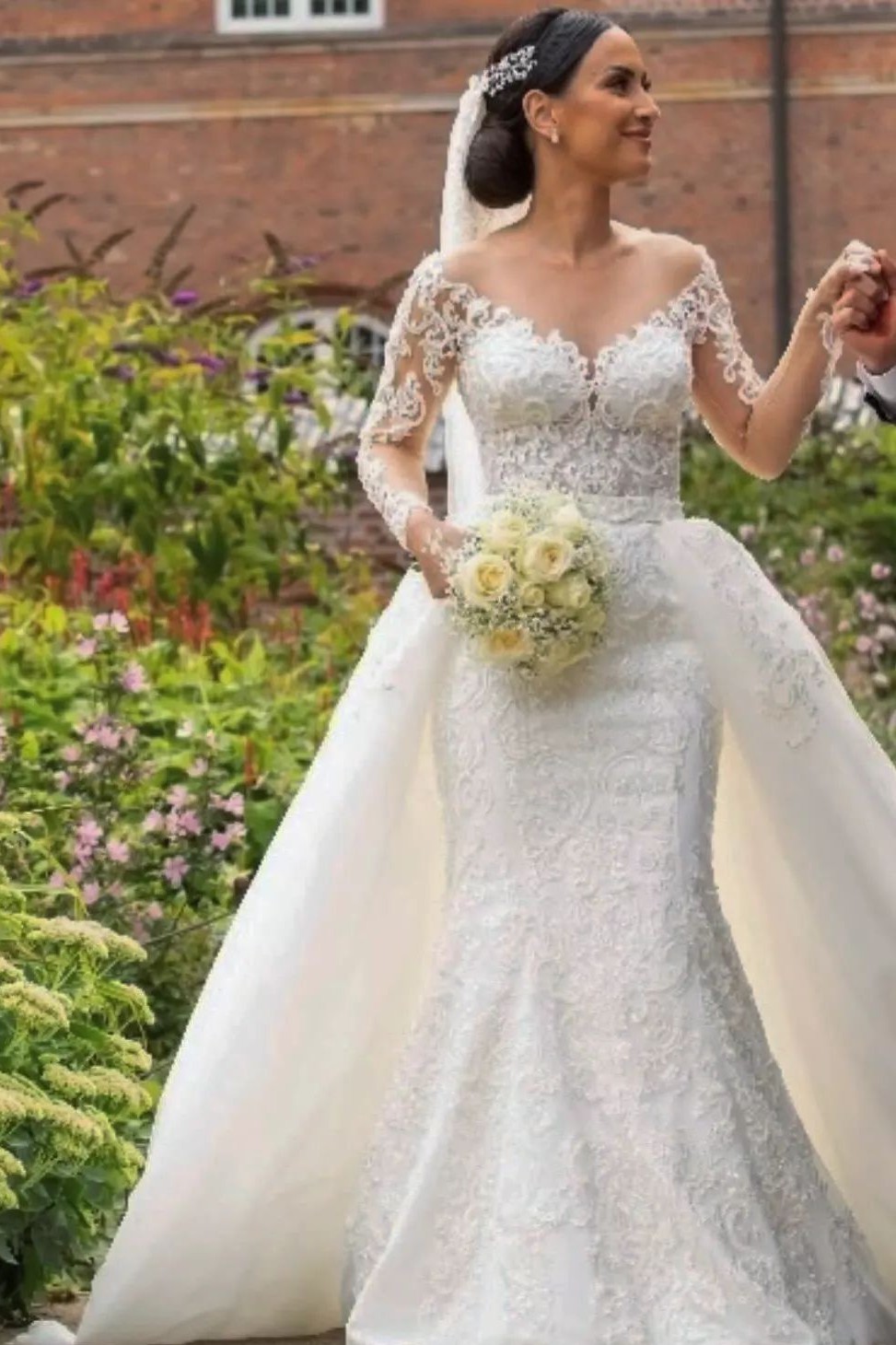
Most detachable trains attach at the natural waist. Some sit lower, at the hip, which suits a mermaid base because it keeps the fitted line unbroken through the hip before the train flares out.
A waist-mounted train on a mermaid gown can create a visible ledge if the fabric is heavy. On satin, ask for the join to sit at the hip; on tulle, the natural waist is fine because there is no bulk to stack.
Sweep, chapel, cathedral — what the length names mean for a removable piece
The length names describe how far the train extends behind you, and they matter more on a detachable piece because all of that fabric has to hang from one seam.
A sweep train barely brushes the floor and adds almost no load. A chapel train extends further and is the most common detachable length. A cathedral train is the dramatic one, and also the heaviest thing you will ask a waist seam to carry.
Does a detachable train hold up through a full wedding day?
Yes — if the weight is matched to the attachment and the base dress is built to carry it. This is a construction question, not a styling question, and it is the part product photos never show you.
The weight problem nobody mentions
A long satin train carries real weight, and all of it pulls down and back from a single horizontal seam. On a strapless bodice that pull is transferred straight to the neckline, which is why some brides find a strapless gown creeping down over the course of a ceremony.
Two things fix it: a base dress with proper internal support, and a train in a lighter fabric than the skirt. Tulle and organza trains give the same visual length as satin at a fraction of the load.
Why the ceremony silhouette should not be the one you fall in love with
Try to picture the gown with the train already removed. That is the dress in your reception photographs, your first dance, and every conversation after dinner. If the base dress only works with the train attached, you have bought a one-hour gown.

Bustling versus detaching
A bustle gathers a fixed train up onto the back of the skirt with ties or buttons. It keeps the fabric with you, adds visual bulk at the hip, and takes a practised helper several minutes.
Detaching removes the fabric entirely. It is faster, it leaves a clean line, and it gives you somewhere to put the train — which is also its weakness. Someone has to be responsible for carrying a large piece of white silk through a venue for the rest of the night.
What actually breaks, and how to prevent it
Failures cluster at three points: a hook pulled out of its stitching, a zip jammed by a caught thread, and the seam itself stretched by repeated attaching and detaching during fittings.
The prevention is boring but effective. Attach and detach the train no more than you need to before the day, ask your tailor to reinforce the waistband hardware when the gown is altered, and have two safety pins in the emergency kit.
Who should choose a detachable train — and who should skip it?
The honest answer is that a detachable train earns its place when your ceremony and your reception have genuinely different requirements. If both happen in the same room with the same forty guests, a fixed sweep train may serve you better.
Mermaid bases give the biggest payoff
A mermaid gown with a cathedral train reads as formal and traditional walking down the aisle, then becomes a sleek, body-skimming column the moment the train lifts off. No other pairing changes the register of a dress that completely.
This is also the combination that most needs correct measurements, because a mermaid silhouette has nowhere to hide a fit problem once the train is gone.
Ball gown and A-line bases: less contrast, more practicality
On a full skirt, removing the train changes the length behind you but not the shape. The payoff is mobility rather than transformation — you stop worrying about guests standing on your train, which on a crowded dance floor is not a small thing.

Long sleeves and high necks change the calculation
A covered bodice already reads as formal, so the train is doing less work. Brides in long sleeves often find the base dress alone is ceremony-appropriate, which makes the detachable train a pure styling bonus rather than a structural necessity.
When a fixed train is the better call
If the train is the entire point of the dress, do not make it removable. Detachability adds hardware, a seam, and a decision to make on the day.
It is worth knowing that separable wedding gowns are not a modern invention.
The V&A's collection includes a 1902 wedding dress by the dressmakers Houghton & Dalton that, as the museum describes it, "consists of a separate cream silk bodice and skirt, which swells into a stately, heavy-lined train".
Modular bridal construction is more than a century old, and it has always been about making one expensive garment do more than one job.
The COCOSBRIDE difference: a train is only as good as the waist it hangs from
Every gown here is made to order, which changes what a detachable train can be. On a stock-size dress the train is engineered for a sample body, and your tailor then adapts a join that was never sized for you.
When the gown is cut to your measurements, the waist seam — the single point carrying the entire train — is built where your waist actually is.
That is why the Custom Size option asks for five measurements rather than a dress size. Bust, waist, hips, hollow to floor and barefoot height together describe where the seam sits and how far the fabric falls, and on a detachable design the waist figure governs both halves of the gown at once.
Production time is listed on each product page, and it is worth reading before you fall for a design, because a made-to-order gown plus alterations is a schedule, not a purchase.
Whatever that production time says, plan on 2-3 weeks between the gown arriving and the wedding so a local tailor can finish the fit without rushing.
Our train wedding dresses collection groups the styles built for this, and it sits alongside the rest of our made-to-order wedding dresses.
Shop the Look: Detachable Train Wedding Dresses
Every style below is a made-to-order gown with a removable train, chosen to cover the range of attachment types and base silhouettes discussed above.

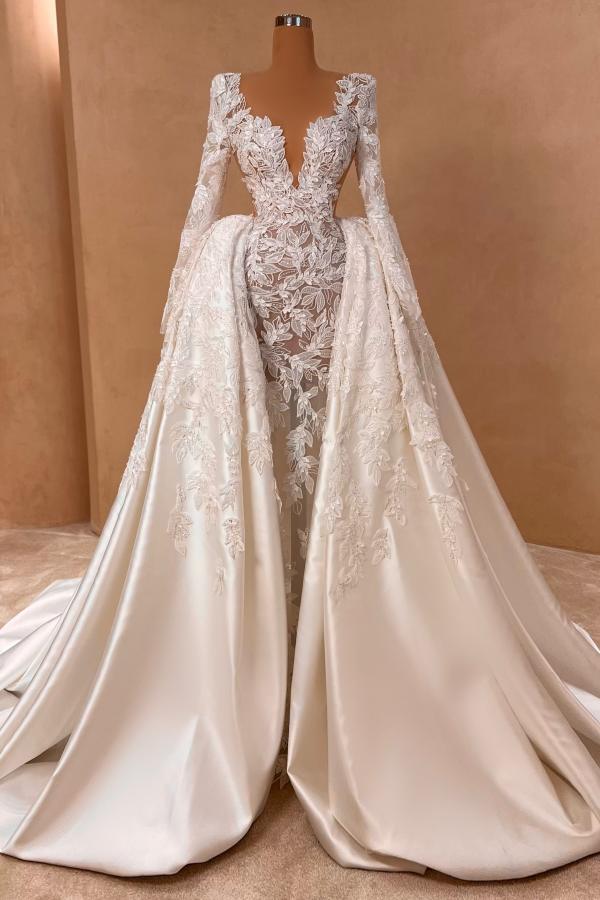

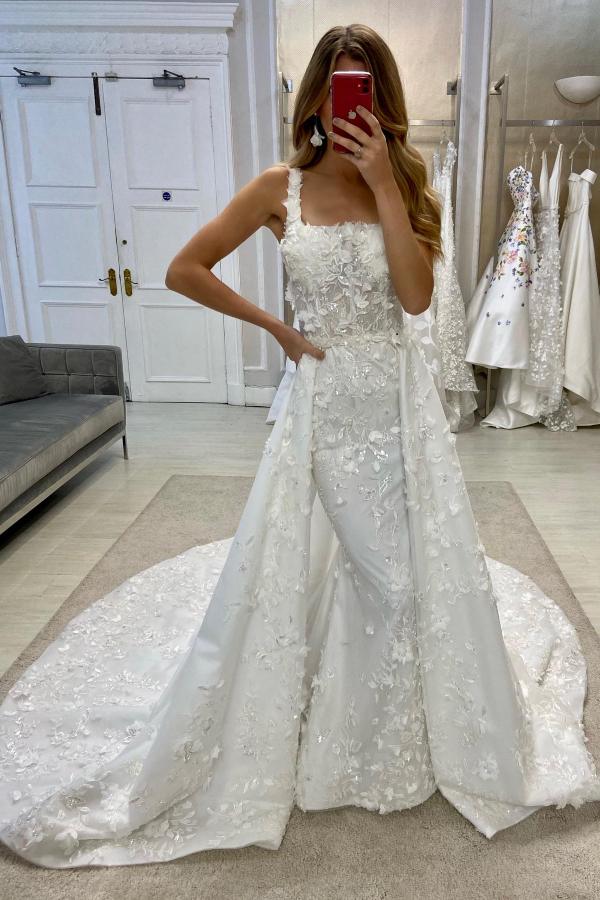


If what you actually want is a fuller ceremony shape rather than extra length behind you, the piece to read next is our guide to wedding dresses with detachable skirts, which covers overskirts and the ceremony-to-reception change in detail.
And because every detachable design lives or dies on how well the bodice holds its position, it is worth understanding what corset lacing does for fit — a laced back is the most adjustable way to carry a train's weight.
Frequently Asked Questions
Can a detachable train be removed without help?
A covered zip can usually be managed alone, but hooks and buttons need a second pair of hands. The hardware sits at the small of your back, which is the one place you cannot see or reach comfortably.
Does a detachable train damage the dress when it comes off?
No, if the waistband hardware was reinforced during alterations. The wear comes from repeated attaching and detaching during fittings rather than from the single removal on your wedding day.
Is a detachable train heavier than a sewn-in one?
It carries its weight differently rather than weighing more. All of the load hangs from one horizontal waist seam instead of being distributed through the skirt, which is why a lighter fabric such as tulle or organza is often the better choice for the removable piece.
What happens to the train after I take it off?
Someone in your party needs to be responsible for it for the rest of the night. This is the practical downside of detaching compared with bustling, where the fabric stays attached to the dress.
Can I add a detachable train to a dress that does not have one?
It depends on the gown's construction, so it has to be checked case by case before you order. Email service@cocosbride.com with the style you are considering and ask whether a removable train can be built into it.
Where can I see detachable train wedding dresses that are actually in stock?
The train wedding dresses collection is the place to start, and every style there is made to order in your measurements.
About the Author
Elena Marsh is a bridal and formalwear writer specialising in wedding dress construction, detachable and convertible design, silhouette selection, and made-to-measure fit. She writes practical shopping guides that help readers balance style, fit, budget, and event-readiness, with a focus on how silhouette, fabric, customization, and measurements affect how a dress looks in real life, not just in product photos.