

A slit is not a cut in the skirt. It is a seam that stops early — the two panels are sewn together from the hem upwards and simply left open above a chosen point. Everything about how a slit behaves comes down to how that stopping point is finished.
Get it right and the opening lies closed when you stand and parts only when you walk. Get it wrong and it gapes the whole time, which is the complaint behind almost every bride who regrets one.
| What it is | A seam left open above a set point, not a cut through the fabric |
| Workable height | Mid-thigh is the practical ceiling for most brides; knee-height is the safest |
| What keeps it closed | Fabric weight and how the edges are finished — not the height |
| Position | Front-centre shows most when walking; a side slit is far more discreet |
The rule worth remembering: book the fitting 4-6 weeks out so there is still time to raise or lower the opening. Changing a slit height means re-finishing the edge along its whole length, which is a slower job than taking in a seam.
How is a slit actually built?
The construction is simple. The finishing is where gowns differ.
The stopping point is reinforced
Where the seam ends, the fabric takes all the strain every time you take a step. A well-made gown has a bar tack — a dense little block of stitching — at that point. Without one, the seam keeps splitting upwards over the course of a day.
This is the detail to ask about, because it is invisible in photographs and it is the one thing that actually fails.
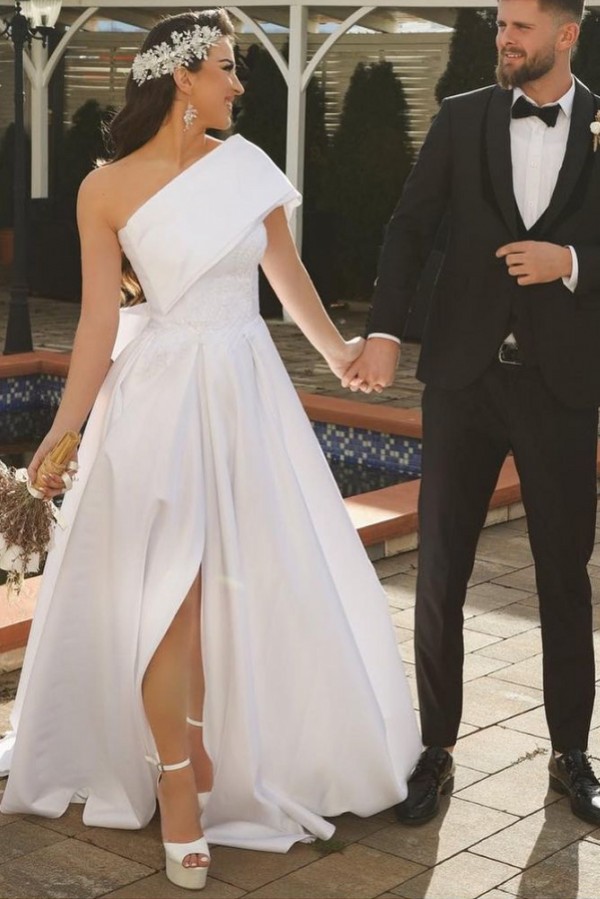
Both edges have to be finished
The two open edges are visible from the inside as well as the outside when you move. On a lined gown they are usually turned and topstitched, or bound with a strip of the same fabric.
Raw or overlocked edges inside a slit are a sign of a rushed make.
The lining has to match
If the outer fabric opens but the lining does not, the slit shows lining instead of leg and the whole effect collapses. The lining should be cut with the same opening, finished the same way, and sitting a fraction shorter so it never peeks out.
Freedom to move is why hems opened in the first place
Openings in formal skirts began as a practical answer to restrictive dress.
The V&A notes that traditional Victorian shapes "did nothing to promote natural movement of the body", while reform styles "allowed the body to move far more naturally" — a shift traced in its account of how Arts and Crafts influenced fashion.
A slit is the same idea in one seam: a fitted skirt you can still walk in.
How high can a slit realistically go?
Higher than most brides end up wanting, once they have walked in it.
The three heights that actually get ordered
Most requests land in one of three places, and they behave very differently:
- Knee height — reads as a detail rather than a feature, stays closed when standing, no practical downsides
- Lower thigh — visible when you walk, closed when you stand still; the most common choice
- Mid-thigh — dramatic and photographs well, but needs the fabric and the underwear planned around it
Above mid-thigh is a different garment
Beyond mid-thigh the opening stops being a slit and starts dictating how you sit, how you climb steps and what you can wear underneath. It is entirely possible to make — it just stops being something you can ignore for a whole day.
Your height changes the answer
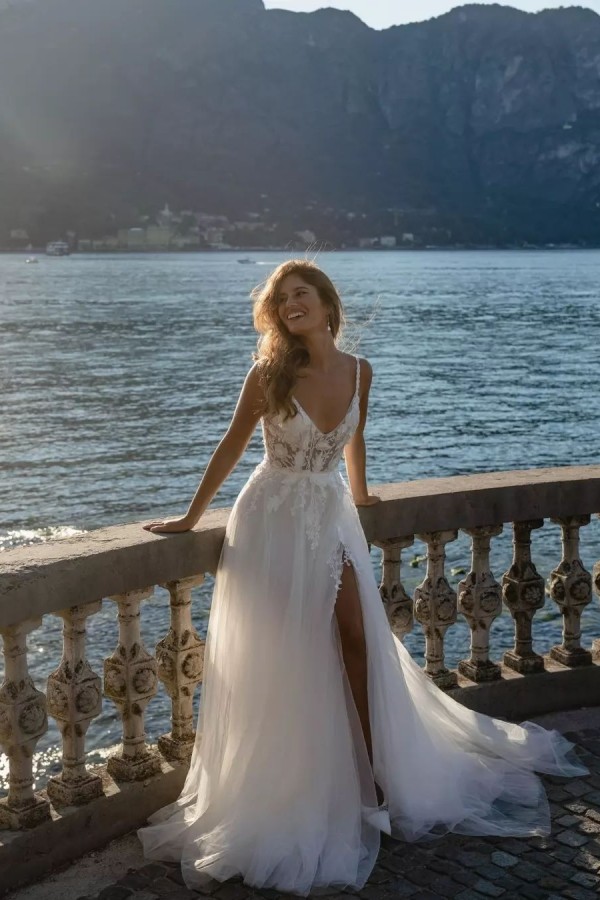
A slit is specified as a distance from the hem, not from your hip. The same pattern on a taller bride ends lower down the thigh; on a shorter one it ends higher. This is one of the clearest reasons to order a slit gown to measurements.
Front or side changes everything
A front-centre slit opens with every stride and is the most visible. A side slit shows only when you turn or shift your weight, which is why brides who want the movement but not the attention almost always choose the side.
What stops a slit from gaping?
Three things, and the height of the opening is not one of them.
Fabric weight does most of the work
Heavy satin and crepe hang straight down and stay closed under their own weight. Light chiffon and tulle drift apart with any movement or breeze, so the same slit height behaves completely differently in two fabrics.
If you want a high slit that stays discreet when standing, choose the heaviest fabric you like the look of.
A weighted or bound edge
Some gowns have a narrow weight or a firm binding worked into the slit edges. It is invisible from outside and it is the reason some openings hang plumb while others curl.
Where the slit sits relative to the seam
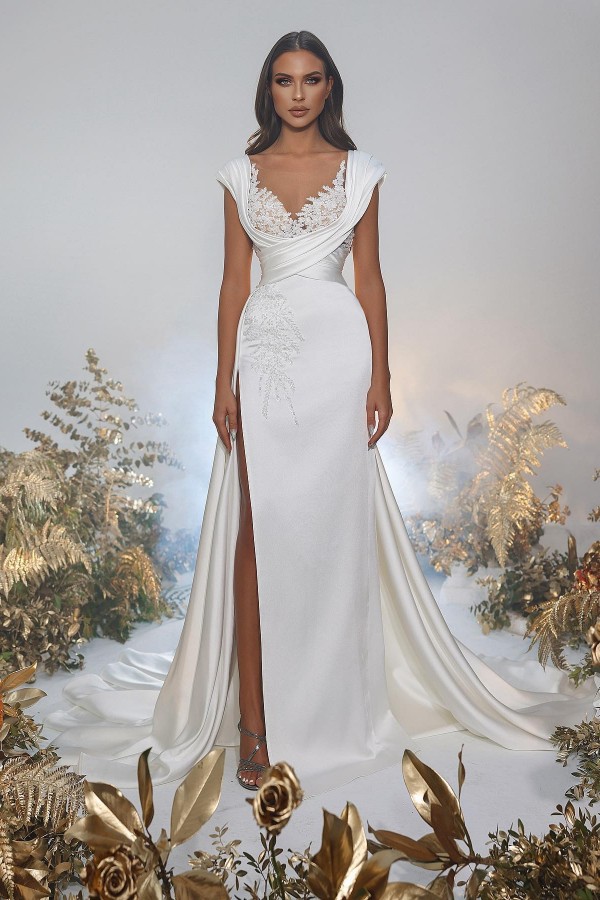
A slit placed exactly on a vertical seam hangs closed. One cut into the middle of a panel has no seam to fall along and tends to flare open. Look at where the opening sits in the product photos.
What to wear underneath
Anything you would rather not show should sit above the stopping point, so plan the underwear around the slit height rather than the other way round. Shorts-style smoothing underwear works well under a high slit; a long-line piece does not.
The COCOSBRIDE Difference: the slit is measured from your hem, on your height
Because a slit is specified as a distance up from the hem, its position on your leg depends entirely on how tall you are. A pattern drafted for a sample height puts the opening somewhere different on almost everyone else.
Ordering with Custom Size means the skirt length and the slit are calculated together from your hollow-to-floor and barefoot height, so the opening ends where it was designed to end — on you, in your shoes.
Slits can also be added to a straight skirt, or an existing one reduced or closed, on many styles. Both change how the skirt hangs, so email service@cocosbride.com with the style number before ordering rather than treating it as an alteration afterwards.
Browse the sexy wedding dresses collection for the styles with an opening built in, or see our full made-to-order bridal range if you are still comparing skirts.
Shop the Look: Wedding Dresses With a Slit
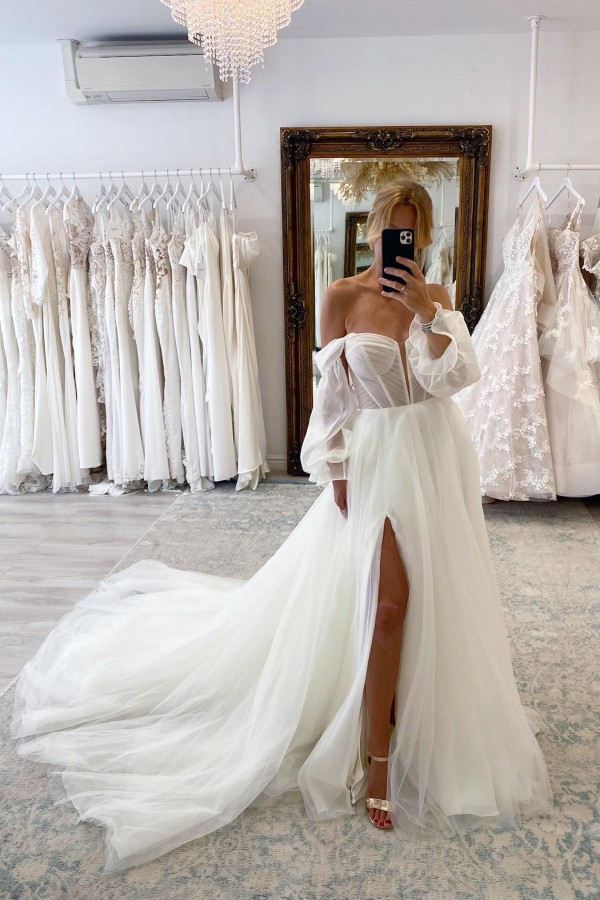
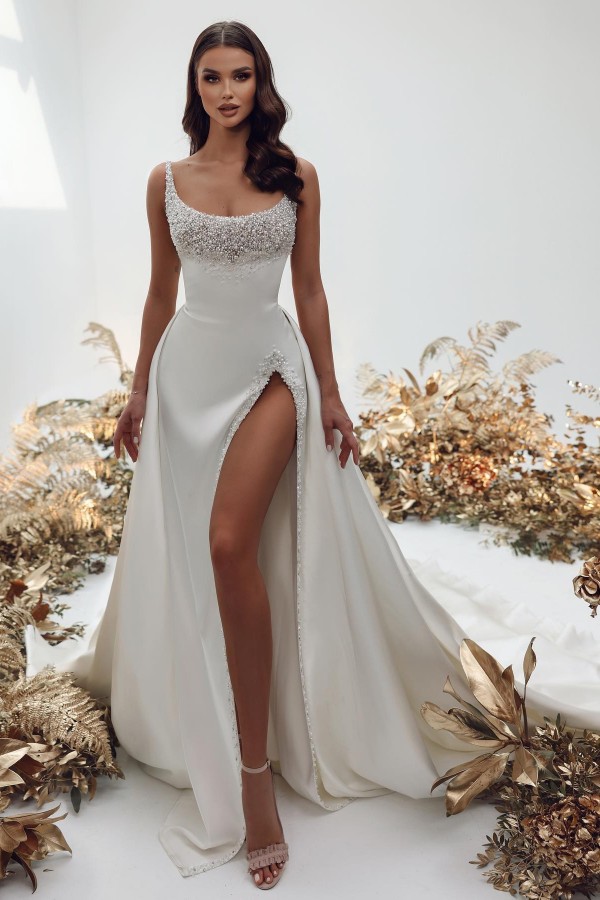
Each gown below has the opening built into a seam and is made to order, so the slit lands at the height it was drawn for.



An open skirt and an open back raise the same question from opposite ends — our guide to backless wedding dresses covers what holds a gown together when you take structure away.
Fabric weight decides how a slit behaves, and nothing changes weight faster than embellishment — see what beading does to weight and fit.
Frequently Asked Questions
How high should a wedding dress slit be?
Knee height reads as a detail, lower thigh is the most commonly chosen, and mid-thigh is the practical ceiling for a full day. Above mid-thigh the opening starts dictating how you sit and what you wear underneath.
What stops a slit from gaping open?
Fabric weight, a bound or weighted edge, and whether the opening sits on a vertical seam. Heavy satin hangs closed under its own weight while light chiffon drifts apart, regardless of how high the slit is.
Is a front slit or a side slit better?
A side slit is far more discreet because it only opens when you turn or shift weight. A front-centre slit opens with every stride, which is more dramatic but much more visible.
Does my height change where the slit sits?
Yes, because a slit is specified as a distance up from the hem rather than from your hip. The same pattern ends lower on a taller bride and higher on a shorter one.
Can a slit be added to a dress that does not have one?
Often yes, and an existing one can usually be reduced or closed. Both change how the skirt hangs, so email service@cocosbride.com with the style number before ordering rather than treating it as a later alteration.
Where can I find wedding dresses with a slit in my length?
The sexy wedding dresses collection holds the styles with an opening built in, each made to order so the skirt length and the slit are calculated together.
About the Author
Elena Marsh is a bridal and formalwear writer specialising in wedding dress construction, detachable and convertible design, silhouette selection, and made-to-measure fit. She writes practical shopping guides that help readers balance style, fit, budget, and event-readiness, with a focus on how silhouette, fabric, customization, and measurements affect how a dress looks in real life, not just in product photos.